

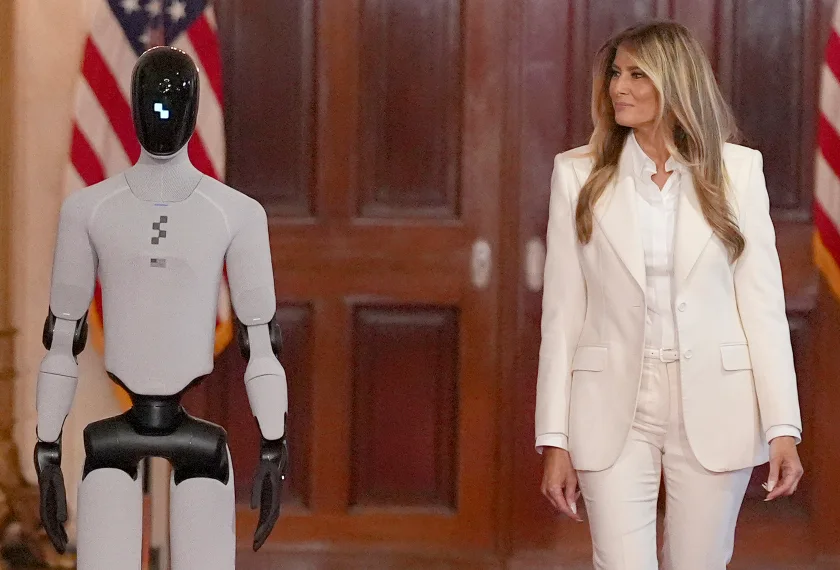
First Lady Melania Trump arrived at a White House technology summit accompanied by Figure 03, a humanoid robot developed by Figure AI, in a moment that underscored how quickly advanced robotics is moving into the public spotlight. The robot walked beside her through the White House Cross Hall, delivered short opening remarks with hand gestures, thanked the first lady, and welcomed the audience in 11 languages.
The summit, held at the White House on March 24 and 25, 2026, focused on how education, innovation, and technology can better prepare children for a digital future. It brought together representatives from 45 countries, first spouses, and major technology companies including Microsoft, Google, and OpenAI.
The appearance was more than a visual spectacle. It placed one of the most talked about humanoid robots in the world inside one of the most symbolic political settings in the United States. Figure AI has emerged as a major player in the race to build robots that could eventually work in factories, warehouses, logistics centers, and, over time, even in homes.
Why Figure AI is attracting so much attention
Founded in 2022, Figure AI has quickly become one of the best funded companies in humanoid robotics. It has attracted backing from major technology names including Microsoft, Nvidia, Salesforce, and Samsung. Last year, the company raised more than $1 billion in Series C funding and reached a $39 billion post money valuation in September.
Its latest model, Figure 03, is being presented as a more refined version of the company’s earlier robots, with a lighter frame, smoother design, and improved speech capabilities. Figure AI has said the robot is expected to cost $24,760, placing it in direct competition with Tesla’s Optimus and 1X’s NEO.
The White House appearance came only days after Salesforce chief executive Marc Benioff shared video of a Figure robot sorting packages in a warehouse, another example of how the company is trying to position its machines as practical tools for real work rather than futuristic novelties.
The larger race in humanoid robotics
Figure’s rise reflects a broader shift across the technology industry. Companies such as Tesla, Agility Robotics, 1X, and Apptronik are all pursuing humanoid robots based on one simple commercial logic: the modern world was built for the human body. Warehouses, assembly lines, tools, shelves, doors, and household spaces are already designed for human movement and reach. A robot with arms, hands, legs, and human like proportions could therefore fit into existing environments without major redesign.
That is why humanoid robotics is being treated as one of the next major frontiers after generative AI. The promise is not just automation, but general purpose automation, meaning robots that could perform many different tasks instead of being limited to one narrow function.
Strong ambition, but major technical hurdles remain
Despite the excitement, the technology is still far from mature. Earlier reporting on Figure described robots that still required warm up time, direct staff support, and repeated training for even basic tasks. That remains one of the central realities of the industry: polished public demonstrations can create the impression of readiness, but dependable real world deployment is far harder.
Building a humanoid robot that can walk reliably, handle objects safely, understand speech, respond in real time, and work for long periods without failure is an enormous engineering challenge. Making that robot affordable enough for factories and warehouses is an additional hurdle. For all the momentum in the sector, many analysts still expect commercialization at scale to take years.
Brett Adcock and the company behind the robot
Figure’s rapid rise has also turned its founder, Brett Adcock, into one of the most visible figures in robotics. Before launching Figure, he cofounded Vettery, which was sold to Adecco, and Archer Aviation, the electric air taxi company. Under his leadership, Figure has hired talent from companies such as Boston Dynamics, Google DeepMind, Tesla, and Apple, while also securing a collaboration with BMW and an agreement with OpenAI.
Adcock has described humanoid robots as a future replacement for large categories of human labor, a vision that has helped attract money, talent, and public attention. It has also placed Figure under pressure to prove that its technology can move beyond highly controlled demonstrations and into dependable everyday use.
Cybersecurity, Compliance, Privacy and more. Get your bestselling copy: The Handbook
A symbolic moment with broader meaning
The White House appearance gave Figure AI something more valuable than publicity alone. It gave the company symbolic legitimacy. A humanoid robot walking beside the first lady signaled that these machines are no longer being treated only as experimental lab projects or investor attractions. They are entering mainstream political, economic, and cultural conversation.
For now, the industry still sits between promise and proof. Figure 03’s appearance showed how far humanoid robotics has come in visibility and presentation. The more difficult test is still ahead: whether companies like Figure can build robots that are not only impressive in public, but useful, reliable, and affordable in everyday work.
DELTA Data Protection & Compliance, Inc. Academy & Consulting – The DELTA NEWS – Visit: delta-compliance.com

