

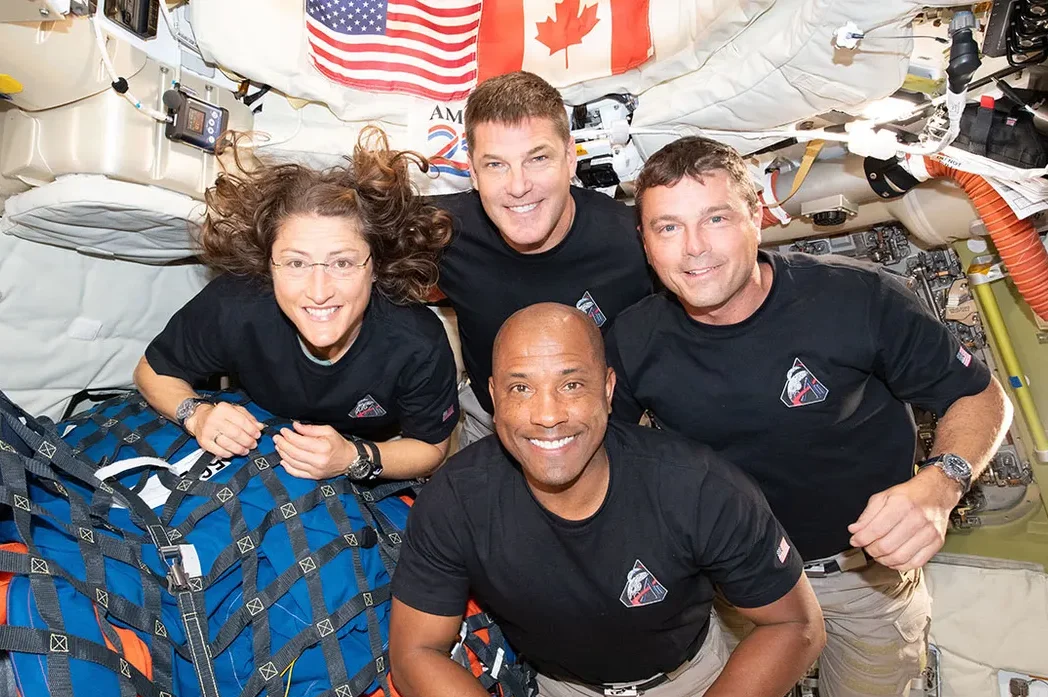
The Artemis II astronauts are now on the final leg of their journey home, having left the Moon’s sphere of influence and re-entered the pull of Earth’s gravity. On Flight Day 8 of 10, NASA’s Orion spacecraft is racing back toward the planet at more than 1,700 miles per hour, setting the stage for a planned Pacific splashdown on Friday evening off the coast of San Diego.
The return marks the closing chapter of a mission already hailed as a defining milestone in modern human spaceflight. Artemis II carried four astronauts farther from Earth than any humans have traveled before, reviving NASA’s crewed lunar program and creating a direct link between the Apollo era and the next generation of Moon missions.
A Mission That Reached Beyond History
Artemis II has already secured its place in history. The mission sent a four member crew around the Moon and deeper into space than any human mission before it, re-establishing crewed lunar travel for the first time since 1972.
Aboard Orion, the “Integrity” crew woke at 11:35 a.m. Eastern on Wednesday and began another busy day of operations, testing, exercise, and reentry preparation. While much of the world’s attention has centered on the lunar flyby and the record breaking distance achieved during the voyage, NASA officials said the focus has now shifted fully to the crew’s safe return.
“After an exciting day of science on Monday and a day for the crew to recover and achieve other flight objectives yesterday, the team is turning our attention to the return and getting the crew safely home,” said NASA Deputy Associate Administrator Lakiesha Hawkins.
Even so, NASA stressed that the mission’s final days remain scientifically important, with teams still collecting data that will help shape future Artemis missions.
— Learn more about Future Jobs & Manager Programs: DELTA Data Protection & Compliance Academy —
Europe’s Contribution Is Coming Home Too
Although Artemis II is a NASA led mission, Europe is deeply built into Orion’s journey. The spacecraft’s European Service Module, provided by the European Space Agency and built with European industry, is a mission critical element of the capsule. It supplies propulsion, power, thermal control, and key life support resources that make the voyage possible.
That means ESA is not standing on the sidelines of this return. A central European contribution is coming back to Earth with the crew, underscoring that Artemis II is not only an American milestone but also a major example of international cooperation in deep space exploration.
In practical terms, Orion could not perform this mission in its current form without Europe’s role. As the spacecraft heads home under Earth’s gravity, it also carries with it the success of one of the most important transatlantic space partnerships of the modern era.
Splashdown Off California Now in Sight
The mission is scheduled to end with a Pacific splashdown on Friday, April 10, at approximately 8:07 p.m. Eastern, west of San Diego. Recovery operations will be led by the USS John P. Murtha, the San Diego based amphibious transport dock ship selected to retrieve both the astronauts and the Orion capsule.
The ship is equipped with a well deck, helicopter support, medical facilities, and communications systems needed for astronaut recovery. MH 60S Sea Hawk helicopters and Navy divers are expected to assist in tracking Orion during reentry, recovering the capsule from the water, and helping the crew safely transition back to Earth.
NASA Says Weather Conditions Look Favorable
NASA flight teams said the forecast currently supports a smooth return. Artemis II Flight Director Rick Henfling said officials are primarily monitoring wind, wave conditions, precipitation, and thunderstorms, but current models remain encouraging. Forecasts call for southwest winds around ten knots, waves below four feet, and rain expected to stay well away from the intended splashdown zone.
A cold front that had raised some concern earlier in the week has weakened and slowed, improving confidence in Friday’s landing timeline. Henfling said the spacecraft remains capable of adjusting its landing profile if necessary, ensuring a safe return even under contingency conditions.
Reentry Will Bring Extreme Speed and Precision
Orion is predicted to reach a peak reentry speed of 34,965 feet per second, just below the Apollo 10 record of 36,397 feet per second. During reentry, the astronauts will be positioned heads down, giving them a view of the horizon as the spacecraft descends through Earth’s atmosphere. Orion will then deploy its parachute system before striking the Pacific Ocean.
NASA officials stressed that the final descent is one of the most critical phases of the mission, requiring both precise spacecraft performance and stable environmental conditions.
Fuel Margins Remain Strong Ahead of Landing
Orion is also returning with substantial reserves. According to Orion Deputy Program Manager Debbie Korth, the mission has used nearly 3,000 pounds of propellant so far, while still retaining more than 4,285 pounds in reserve. She said those margins reflect the conservative planning built into the mission from the beginning.
The remaining reserves provide confidence that Orion has had the flexibility needed to perform safely throughout the mission and return under strong operational margins.
Crew Prepares Body and Spacecraft for Earth Return
As splashdown nears, the astronauts are carrying out both physical and technical preparations. On Wednesday, the crew completed flywheel exercise sessions designed to maintain strength and cardiovascular conditioning in deep space. They also tested orthostatic intolerance garments worn beneath their suits, which help stabilize blood pressure and circulation as astronauts re-adapt to Earth’s gravity after days away from the planet.
Later in the mission day, the crew was scheduled to conduct manual piloting demonstrations. These include using Orion’s docking camera to point toward a celestial body, centering Earth in the spacecraft window, and maneuvering Orion so that its tail points toward the Sun.
NASA says these demonstrations are important because they show the crew can manually orient the spacecraft for power generation and system management if required.
Stunning New Views From the Journey Home
Even during its return, Artemis II continues to deliver extraordinary imagery.
NASA released dramatic new photographs this week from the far side of the Moon, showing cratered terrain and basins in striking detail. The agency also shared images of Earth, the Moon, and the Milky Way, giving the public a rare visual record of deep space from a human crewed spacecraft.
Among the most notable images was an “Earthset” photograph, evoking Apollo 8’s iconic 1968 “Earthrise” image. The visual parallel is powerful. Just as Apollo 8 helped define the first era of lunar exploration, Artemis II is now shaping the second.
— Learn more about DELTA Data Protection Manager Courses: DELTA Academy & Consulting —
A Human Moment Between Two Crews in Space
One of the most memorable moments of the return came during a rare call between the Artemis II astronauts and the crew aboard the International Space Station. During the conversation, both crews joked about trying to outdo one another in claiming the title of being the furthest from Earth, with astronauts on both spacecraft teasing that they had moved to the farthest possible corners of their cabins for bragging rights.
Behind the humor, however, the exchange carried genuine emotional weight. The astronauts reflected on the wonder of being off the planet at the same time, in entirely different regions of space, yet still connected through a shared mission of exploration. Commander Reid Wiseman described the exchange as deeply meaningful, noting that all of them are currently away from Earth and will soon return to the same home planet.
Jeremy Hansen Draws Praise From Canada
Canadian astronaut Jeremy Hansen, the first Canadian ever to travel to the Moon, also spoke Wednesday with Prime Minister Mark Carney.
Carney praised Hansen and the Artemis II crew for setting an example of ambition and perseverance, telling them that Canadians could not be more proud. Hansen responded by reflecting on the importance of resilience in national space programs, saying countries must be prepared to endure failures, persist through them, and ultimately succeed. His remarks underscored how Artemis II is not only an American milestone, but also a broader international achievement.
Millions of Names Are Coming Home With the Crew
NASA also highlighted one of the mission’s most symbolic details: a plush zero gravity indicator named “Rise,” which is carrying more than 5.6 million names submitted by people around the world through the “Send Your Name with Artemis” campaign.
— Cybersecurity, Compliance, Privacy and more. Get your bestselling copy: The Handbook —
The names are stored on an SD card inside the mascot, turning Rise into a small but powerful emblem of public participation in the mission. Commander Wiseman said placing that memory card inside the plush indicator was more emotional than expected, because it made the mission feel as though it was being carried out on behalf of millions.
The End of Artemis II, and the Start of What Comes Next
With Orion now less than 200,000 miles from Earth, mission control says the remaining days will focus on operations, data gathering, and final return readiness. Radiation monitoring, crew conditioning, solar flare protection procedures, and manual spacecraft demonstrations all remain part of the closing schedule.
At the same time, NASA is already preparing for Artemis III, signaling a faster pace for the lunar program than in previous eras. Even before Artemis II has splashed down, early logistical moves are already underway to shorten the turnaround between missions.
Still, for now, the world is watching the return. If splashdown proceeds as planned Friday evening, Artemis II will close as one of the most consequential human space missions in decades: the first crewed journey to the Moon’s vicinity since 1972, the mission that carried astronauts farther into space than ever before, and the flight that transformed NASA’s renewed lunar ambitions from promise into reality.
DELTA Data Protection & Compliance, Inc. Academy & Consulting – The DELTA NEWS : delta-compliance.com
image credit: NASA

